

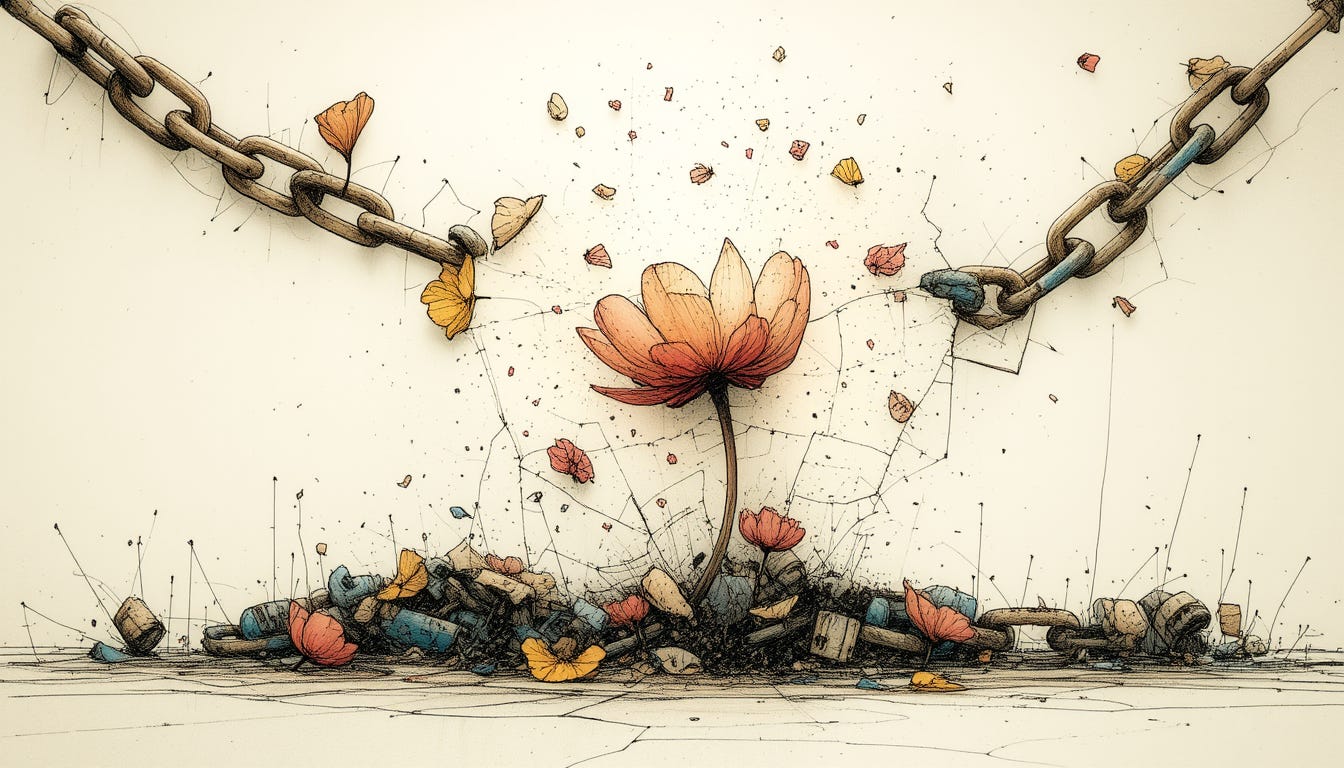
For years, I have been struggling with forming intimate relationships. It didn’t matter if it was deep friendships or romantic partners — something always prevented me from creating the same bonds I saw developing all around me.
It’s not that I didn’t want to have deep connections; I just couldn’t do it. My pattern was always to meet many ‘friends’ quickly, but as soon as they got to know the real me, they pulled away (or so I thought).
It made it very easy for me to live a nomadic lifestyle because I didn’t get attached to others and could move to another country in a heartbeat. I had no trouble saying goodbye to people, and would easily give up whole friendships without ever missing anyone.
Avoidant attachment style
I had no idea that my behavior was linked to an avoidant attachment style, which had formed in my childhood (like all attachment styles typically do). I thought people didn’t like the real me, so I always put up a persona to fit in.
This worked great for a few months, but people would eventually realize that I wasn’t myself, and they’d pull away from me. It left me in confusion because I’d see all around me that other friends were getting closer instead of more distant. And I had no idea what I was doing wrong. After all, I was trying to behave exactly like them.
I helped them wherever I could, always showed up for everybody, and was overly friendly. I didn’t have personal boundaries and did everything to make sure people would perceive me as likable.
Turned out that was exactly the problem — you can only pretend for so long to be somebody you’re not.
If you wonder what your attachment style is, this test is the best I’ve found so far.
Fearful avoidant or dismissive avoidant?
There are two types of avoidant attachment: dismissive (the most common one) and fearful. People with a dismissive avoidant attachment style have a strong desire to be independent and feel like they can’t rely on other people. They feel uncomfortable when others get emotionally close, and they tend to push their partners away.
Somebody with fearful avoidant (also called disorganized) attachment has a mix of both anxious and avoidant at the same time, which creates a push/pull dynamic in relationships. They sometimes want closeness and validation, and the next moment, they push people away. Their relationships are very chaotic.
I personally used to oscillate between the two. If I really like somebody, I get more fearful-avoidant and desire a connection, but it also scares me. But when I am not that into someone, my typical behavior is dismissive avoidance.
Distant in relationships
When I got into my first serious relationship when I was 27 years old, my avoidant attachment style showed up in full force. I still had no idea what it was at the time and blamed a lot on my partner. I almost felt like he tricked me into being in a relationship with him, and now I had to deal with all these unwanted issues.
It must have been very hard for my ex to be with me. The more he tried to be close to me, the further I pushed him away. I was dreaming of being single again and glorified my life as a solo traveler.
The truth, however, was that I did want emotional intimacy more than ever. I was jealous of the people who seemed so natural in forming strong relationships. The more I couldn’t do it, the more I got convinced that something must be wrong with me.
Signs you have an avoidant attachment style
Having an avoidant attachment style is not easy for the people around you. Independence was my middle name, and I was wearing it proudly.
Avoidant attachment develops in children who do not experience sensitive responses from a parent or caregiver to their needs or distress. Children with avoidant attachment may become very independent, both physically and emotionally. — Medical News Today
But the more independent I became, the more distant my relationships turned out to be. Relationships form because you bond over vulnerability and by sharing your deepest emotions. If you can’t do that, people naturally pull away at some point.
So, how does it really feel to have an avoidant attachment style? You might recognize these signs:
1. You don’t feel attached to anybody
Many spiritual teachings say that attachment is the core of all suffering. But humans are social beings, and we naturally attach to others. There is a big difference between codependency and attachment, but to form a deep bond with somebody, there has to be some sort of attachment involved.
If you are somebody who easily lets go and doesn’t miss others often, this could be the first sign of an avoidant attachment style.
2. You are extremely independent
It’s great to be self-sufficient and not overly dependent, but there is also a thing called hyper-independence. You think you can do everything alone, and you never need help. You even prefer not to ever ask for help — you think you can do it yourself better anyway.
I personally hated asking others for help because I didn’t want to be a burden to anyone. I preferred to pay somebody to help me rather than ask for a favor. Extreme independence often goes hand in hand with avoidant attachment.
3. You feel trapped in relationships
Even though you probably want to be in a relationship, they also make you feel trapped. You suddenly feel like things are expected of you, and you don’t like it. You might see your partner as clingy or asking for too much.
Relationships for me felt like a cage. I was longing for my freedom and would find ways to exclude my partner from my life. I needed a lot of alone time and did not like it at all when my partner surprised me with a visit when I thought I was going to be alone.
I felt like I was slowly suffocating in the relationship and was trying to find a way out all the time. The only thing that kept me sane was the dream of being single again.
4. Showing emotions makes you feel uncomfortable
I hated showing my emotions. They made me extremely insecure, and I did not want anybody to ever see me cry. At some point, I had so many suppressed emotions that I couldn’t even cry at all anymore.
Other people’s emotions also made me feel uncomfortable, as I didn’t know how to act around them. I couldn’t even handle my own emotions — what was I supposed to do with those of others?
People with an avoidant attachment style often have a hard time showing their feelings. They learned at a young age that it didn’t feel safe to express themselves, so they turned away from them.
5. You find ways to dislike your partner
If you are avoidant, commitment makes you want to run away. Subconsciously, it’s so scary to commit because you are sure you will get hurt. So, you will find ways to dislike your partner to justify your reason for breaking up.
You suddenly get irritated by the little things they do and keep calling them out on them. You look for a sign to tell yourself they are not the right partner for you. Most likely, you actively start doing certain things more of which you know your partner doesn’t like.
And then blame it on them that they don’t fit with your lifestyle.
6. You avoid making future plans
Avoidants are afraid to commit. It doesn’t matter if this is a relationship, a permanent place to live, a job, or a plan for the future.
Planning is the hardest thing ever for me. How can I know what I am going to do in a month?! Maybe something else comes up, and then I can’t change it anymore… I avoid making future plans at all costs because I want to keep all my options open.
This is a classic sign of avoidant attachment style.
7. People keep pulling away from you
I was afraid that people would reject me when I was my authentic Self, so I always tried to fit in with everybody. Because of this, people mostly perceived me as friendly and approachable. I tried my best to be liked and hid parts of myself that I knew others wouldn’t appreciate.
But I wanted to be accepted so badly that this “friendliness” turned into people-pleasing. And the more I pleased, the more resentment I felt when people would still pull away.
So in return, I detached even more from them — proving to myself that indeed it’s better to only rely on myself.
8. You’re deeply insecure
I falsely linked my independence with being secure about myself, but I couldn’t be more wrong. I was so independent, especially because I was too insecure to show the real me.
It was all rooted in a lack of knowing who I was. I was so used to pretending to fit in that I lost the connection to myself. This disconnection from my Soul turned out to be the biggest reason for my avoidant attachment style.
I kept running away — not just from others, but from who I truly was.
9. You feel like you can’t really trust others
There used to be a deep fear in me that others couldn’t be trusted. I was afraid I had to end up doing things by myself anyway, and people wouldn’t show up for me.
Actually, I only trusted myself for a long time. I knew what I had to do in my life and didn’t want to rely on anybody else. At some point, I even developed a sort of paranoia. When people did something nice to me, I thought there had to be an external reason behind it that I had to eventually pay the price for.
Trust issues are another sign of an avoidant attachment style.
How I changed my avoidant attachment style
When I finally became aware of my repeating relationship issues, it still wasn’t easy to change them. To be honest, it also felt kind of safe to be this avoidant.
But I was longing for real human connection and deep friendships, so I had to do something. The one thing that worked the most for me was shadow work. I got to recognize and accept parts of myself that I had hidden for so long.
It was not an easy journey at all, and on top of that, it was paralleled by a spiritual awakening and an intense break-up. I sank so deep that I was literally stripped bare of everything I thought I was.
If you are ready to change your attachment style, I highly recommend starting with shadow work. I just published my own shadow work journal, especially for people with Anxious and Avoidant Attachment styles.
The benefit of changing your attachment style
My relationships now are so much more satisfying, and I am not afraid to express my different opinions toward others anymore. If they don’t like me for that reason, it’s probably better that we are not friends anyway.
It’s so liberating to not have to people-please anymore and stand my ground in the way I live my life, whether others approve of it or not. Of course, I am still sometimes triggered, but I now embrace it because triggers teach me a lesson about myself.
I recognize attachment issues in others as well now, and I can protect myself from them. Seeing my avoidant attachment slowly change into secure has brought me so many benefits, and it finally feels like I can be my authentic self.
And when you can be your true self around others, that’s when deep bonds and intimacy form sustainably.
It took me 37 years to move from a fearful-avoidant to a secure attachment style, and what helped the most was shadow work. This type of work exposes you to your own wounds, so you can heal them. It’s confronting but necessary — after all, if you don’t really know yourself, you can’t help yourself either.
That’s why I wrote a shadow work journal, especially for attachment styles. Click here to download a free sample!
I'm so glad you found a way to move from an avoidant to a secure attachment style, and find fulfilling connections now. I relate with you in all the experiences yous hared. Being deeply insecure is new; I didn't realize how intricately it's tied to being an avoidant. You've given me much to think about. Thank you for writing and sharing, Yvette.